Finding a place to run in Japan is almost unfairly easy. You don’t need insider tips, Strava heatmaps, or a local running group whispering secrets. Open Google Maps, type the word “park”, and chances are you’ll find someone jogging there before the sun fully wakes up. Ueno Park is a perfect example. Early morning, before tourists and school trips take over, it quietly belongs to runners, dog walkers, and people who look like they’ve been doing this routine for decades.
If you want something calmer, prettier, and slightly more poetic, just search for anything with “garden” in its name. That word usually comes with trees, ponds, carefully framed views—and an entrance fee. Most parks in Japan are free and democratic. Gardens, on the other hand, are curated experiences. You pay a few hundred yen not just to enter, but to step into controlled beauty. Running there feels less like exercise and more like moving meditation, although you’ll always be aware you’re a guest in someone else’s quiet.
Yes, you can run in the city. Japan has excellent sidewalks, and pedestrians generally respect personal space. But as a runner, you also feel an unspoken responsibility not to become a moving obstacle. The last thing you want is to zigzag through commuters who are just trying to get to work on time. Running is supposed to clear the mind, not mildly irritate strangers. So while urban running is possible, it never feels like the best option.
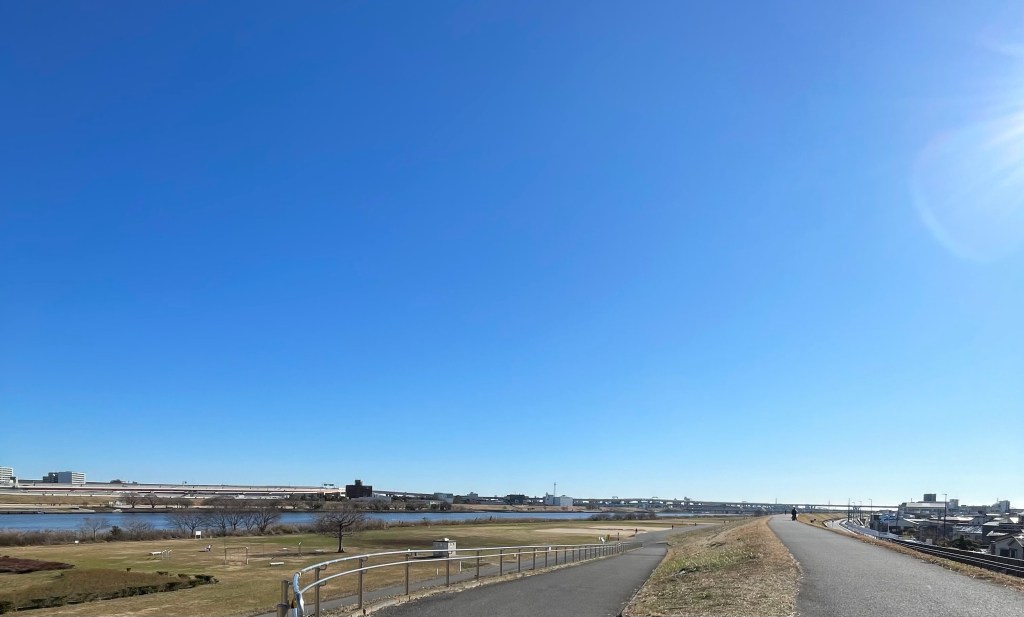
If you happen to stay near a river, congratulations — you’ve accidentally unlocked the best running route in Japan. Japanese rivers are different. Not romantic-different or postcard-different, but structurally, deliberately different. They are wide. Almost suspiciously wide. On normal days, the amount of water flowing through them looks far too small for the space provided. And that emptiness is exactly the point.
That wide open space is called 河川敷 (kasenji), the riverbank or riverbed area designed to flood when necessary. More specifically, much of it is classified as 高水敷 (kōsuishiki) — the high-water channel floodplain. It stays dry most of the year, but during heavy rain, typhoons, or snowmelt, it becomes part of the river. Japan doesn’t fight floods by squeezing rivers tighter. It prepares by giving them room.
The running paths you love are usually built on the 堤防 (teibō), the embankment or levee. This is the higher ground, engineered to stay safe even when the water rises. Below it, the floodplain can turn into a temporary lake. Baseball fields, soccer pitches, grass fields — all sacrificial by design. These spaces can be flooded, damaged, and rebuilt. Homes cannot. It’s disaster management disguised as public space.
This philosophy makes Japanese rivers feel unusually calm for runners. There’s no constant fear of overflow, no sense that the city is recklessly challenging nature. Instead, there’s acceptance. The river will flood. The country knows it. So it plans for it. That’s why rivers often feel more runnable than scenic. They are functional first, peaceful as a bonus.
I had my chance to run along the Arakawa riverbanks, and it was everything a runner secretly wants. Long, uninterrupted paths. No traffic lights. No crowds. Just a steady rhythm, the sound of wind, and the feeling that the city has stepped back to let you breathe. It’s not flashy. It doesn’t try to impress. It just works.
Of course, there is a downside. Because these floodplains are massive open fields, the wind has absolutely nothing to stop it. On calm days, it’s refreshing. On windy days, it feels like the river is personally testing your commitment to the run. You learn quickly that running beside a Japanese river is not about pace. It’s about acceptance — of weather, resistance, and the fact that sometimes the return leg will feel twice as hard.
In the end, running in Japan feels easy not because it’s effortless, but because the country quietly removes friction. Parks exist. Gardens are protected. Rivers are respected. Space is intentionally left empty. For a runner, that emptiness becomes freedom. And when you’re running along a kasenji, knowing it exists because Japan plans for chaos before it arrives, every step feels a little more thoughtful — and a lot more intentional.

 Rundefeated
Leave a comment